
2026 Outlook - Toward Scalable Industrial Intelligence Infrastructure
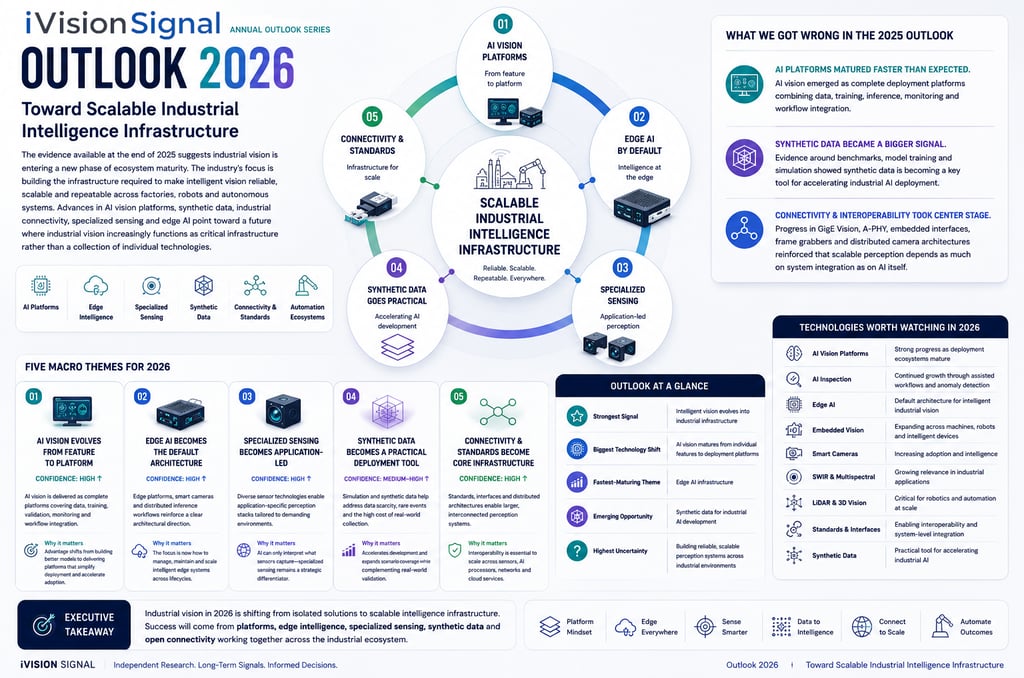
The evidence available at the end of 2025 suggests industrial vision is entering a new phase of ecosystem maturity. The industry's focus is no longer simply deploying intelligent vision—it is building the infrastructure required to make intelligent vision reliable, scalable and repeatable across factories, robots and autonomous systems. Advances in AI vision platforms, synthetic data, industrial connectivity, specialized sensing and edge AI point toward a future where industrial vision increasingly functions as critical infrastructure rather than a collection of individual technologies.
Looking Back: What Did We Get Wrong?
What we got right
We correctly anticipated that industrial vision would increasingly be viewed as operational infrastructure rather than isolated AI applications. Deployment, reliability and maintainability became central industry priorities.
What surprised us
We expected much of the industry's attention to shift toward increasingly sophisticated AI models. Instead, the strongest commercial momentum centered on making existing AI systems easier to deploy, validate and scale through better software platforms, connectivity, standards and engineering workflows.
Where we were too optimistic
We expected AI vision platforms to become more standardized. Instead, the ecosystem remained highly fragmented across software vendors, edge hardware, sensors and deployment frameworks, reinforcing the importance of system integration expertise.
Five Macro Themes for 2026
1. AI Vision Evolves from Feature to Platform
Confidence: High
By the end of 2025, AI vision is increasingly being delivered as complete deployment platforms rather than isolated algorithms.
Commercial activity now extends beyond model performance to encompass data preparation, annotation, training, validation, monitoring and lifecycle management, reflecting an industry focused on simplifying industrial AI deployment.
Why it matters
The industry's competitive advantage is gradually shifting from building better AI models to delivering complete AI vision platforms that reduce deployment complexity and accelerate operational adoption.
2. Edge AI Becomes the Default Architecture
Confidence: High
Edge AI remains one of the strongest long-term signals across the industrial vision ecosystem.
Embedded AI platforms, smart cameras, rugged industrial computers and distributed inference workflows increasingly reinforce a common architectural direction: intelligence belongs alongside machines rather than inside centralized cloud infrastructure.
Why it matters
The debate is no longer whether edge AI should be adopted. It is how to manage, maintain and scale increasingly intelligent edge systems throughout long industrial lifecycles.
3. Specialized Sensing Becomes Increasingly Application-Led
Confidence: High
Sensor innovation continues accelerating across SWIR, SPAD, Time-of-Flight, LiDAR, event-based sensing, hyperspectral imaging, thermal imaging, HDR, RGB-IR and advanced CMOS architectures.
Rather than converging around a single technology, industrial vision is increasingly assembling application-specific perception stacks tailored to individual operating environments.
Why it matters
Artificial intelligence can only interpret the information sensors provide. As industrial applications become more demanding, specialized sensing remains a strategic differentiator rather than a supporting technology.
4. Synthetic Data Becomes a Practical Deployment Tool
Confidence: Medium–High
Synthetic data emerged as one of the year's most important new signals.
Growing activity around simulation, benchmarking, model fine-tuning and AI development workflows suggests synthetic data is becoming an increasingly practical method for addressing limited training data, rare defects and expensive data collection.
Why it matters
Synthetic data is unlikely to replace real-world validation, but it has the potential to significantly reduce one of industrial AI's largest deployment bottlenecks by accelerating development and expanding scenario coverage.
5. Connectivity and Standards Become Core Infrastructure
Confidence: High
As industrial vision systems become increasingly distributed, connectivity is emerging as a strategic capability rather than an implementation detail.
Continued progress around GigE Vision, A-PHY, embedded vision interfaces, frame grabbers and distributed multi-camera systems reflects an ecosystem preparing for larger, more interconnected perception architectures.
Why it matters
Future perception systems will increasingly combine multiple sensors, AI processors, robot controllers, factory networks and cloud services. Standards and interoperability are becoming essential infrastructure for scaling intelligent vision across complex industrial environments.
Outlook at a Glance
Strongest Signal Intelligent vision evolves into industrial infrastructure
Biggest Technology Shift AI vision matures from individual features to deployment platforms
Fastest-Maturing Theme Edge AI infrastructure
Emerging Opportunity Synthetic data for industrial AI development
Highest Uncertainty Building reliable, scalable perception systems across industrial environments
Technologies Worth Watching in 2026
AI Vision Platforms Strong progress as deployment ecosystems mature
AI Inspection Continued growth through assisted workflows and anomaly detection
Edge AIDefault architecture for intelligent industrial vision
Embedded Vision Expanding across machines, robots and intelligent devices
Smart Cameras Increasing onboard intelligence and AI workflow integration
Synthetic Data Growing role in model development and validation
SWIR Imaging Strong application-specific momentum
SPAD Imaging Strong research with selective commercialisation
Time-of-Flight & 3D Vision Continued application-led expansion
Event-Based Vision Early ecosystem momentum continues
Hyperspectral & Multispectral Imaging Meaningful growth in specialist inspection
Machine Vision Standards Increasing importance for distributed systems
Robotics Vision Strong adoption momentum
Sensor Fusion Increasing role in autonomous and semi-autonomous systems
Technologies Requiring More Evidence
Several technologies continue strengthening as long-term signals but have yet to demonstrate widespread industrial maturity.
These include:
Foundation models for large-scale industrial deployment
Fully autonomous inspection
Event-based vision
Commodity 3D vision
Synthetic data as a replacement for real-world validation
Each represents an important direction of travel, but current evidence continues to support incremental operational maturity rather than rapid ecosystem transformation.
Areas of Highest Uncertainty
Industrial vision's remaining challenges increasingly concern operational scalability rather than technical feasibility.
Key questions include:
Can AI vision platforms reduce deployment effort sufficiently to scale across diverse industrial environments?
Will synthetic data significantly accelerate industrial AI development while maintaining real-world reliability?
Can edge AI systems remain maintainable throughout long industrial lifecycles?
Which specialized sensing technologies will move beyond premium applications?
Will connectivity standards evolve quickly enough to support increasingly distributed perception architectures?
Can robotics and automation vendors deliver repeatable intelligent vision solutions rather than custom engineering projects?
Outlook Summary
Industrial vision enters 2026 as an increasingly connected, software-defined and infrastructure-oriented technology ecosystem.
The strongest evidence available at the end of 2025 suggests the industry's future will be shaped by the convergence of specialized sensing, edge AI platforms, AI vision software, synthetic data, industrial connectivity and robotics integration into scalable perception infrastructure.
Research remains active. Commercialization continues to broaden. Integration is strengthening. Operational maturity continues to improve.
The defining question for 2026 is no longer whether intelligent vision can deliver value. It is whether the ecosystem can transform increasingly capable technologies into reliable infrastructure that scales consistently across factories, machines and autonomous systems.
Connect
Questions? Reach out anytime.
hello@ivisionsignal.com
© 2025. All rights reserved.