
2025 Outlook - Toward Operationalized Industrial Perception
The evidence available at the end of 2024 suggests industrial vision is entering a phase of operational maturity. The industry's focus is no longer simply deploying intelligent vision—it is making intelligent vision reliable, repeatable and maintainable across real industrial environments. Advances in anomaly detection, edge AI, specialized sensing, machine vision standards and robotics integration point toward a future where industrial vision increasingly functions as operational infrastructure rather than isolated technology demonstrations.
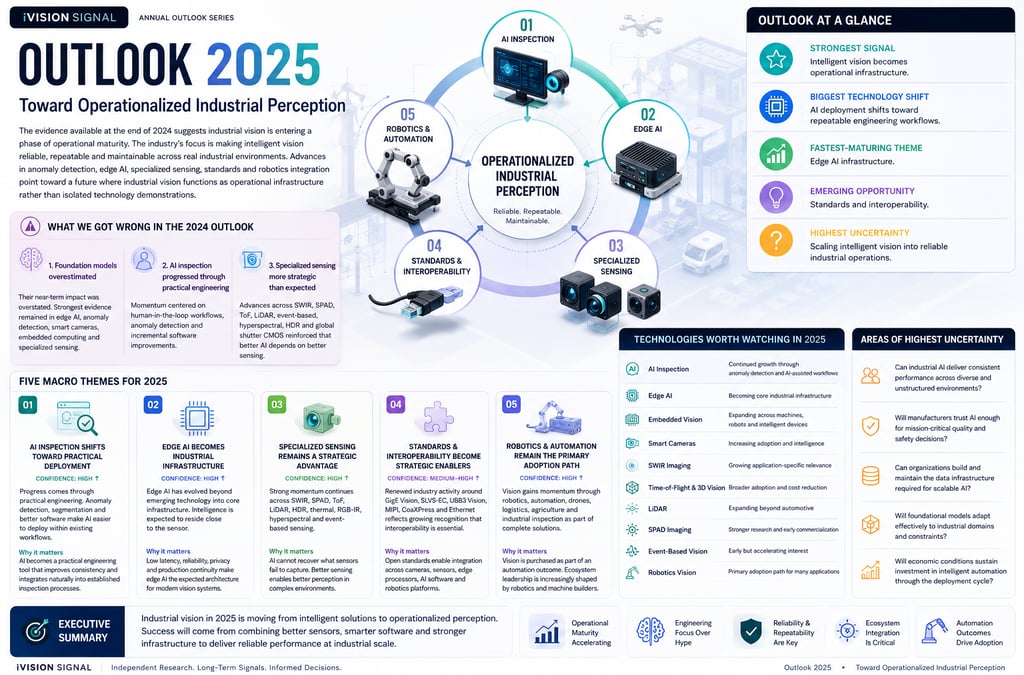
Looking Back: What Did We Get Wrong?
What we got right
We correctly identified the growing importance of AI-assisted industrial intelligence and the continued convergence of sensing, embedded computing and robotics.
What surprised us
We underestimated the strategic importance of interoperability. Machine vision standards, industrial connectivity and software ecosystem integration became increasingly important as vision systems evolved into distributed perception platforms.
Where we were too optimistic
We expected foundation models to have a larger commercial impact during 2024. Instead, the industry's strongest momentum remained focused on practical deployment improvements such as anomaly detection, edge AI and operational reliability.
Five Macro Themes for 2025
1. AI Inspection Shifts Toward Practical Deployment
Confidence: High
AI inspection remained one of the industry's strongest themes throughout 2024, but progress increasingly came through practical engineering rather than breakthrough algorithms.
Anomaly detection, image segmentation, guided model training, defect detection and continuous improvements to commercial inspection software all point toward an ecosystem focused on making AI easier to deploy within existing industrial workflows.
Why it matters
The industry's next phase is not about replacing inspection engineers. It is about making AI a more practical engineering tool that simplifies deployment, improves consistency and integrates naturally into established inspection processes.
2. Edge AI Becomes Industrial Infrastructure
Confidence: High
By the end of 2024, edge AI had evolved beyond an emerging technology into core industrial infrastructure.
Embedded AI computers, rugged edge platforms, smart cameras, NVIDIA Jetson ecosystems and multi-camera processing workflows increasingly reflect an industry where intelligence is expected to reside close to the sensor.
Why it matters
Low latency, reliability, privacy and production continuity continue to favour local intelligence. Edge AI is no longer a deployment option—it is becoming the expected architecture for modern industrial vision systems.
3. Specialised Sensing Remains a Strategic Advantage
Confidence: High
Sensor innovation continues to be one of the strongest long-term signals across industrial vision.
Momentum remains strong across SWIR, SPAD, Time-of-Flight, solid-state LiDAR, HDR, thermal imaging, RGB-IR cameras, hyperspectral imaging and event-based sensing.
Why it matters
Artificial intelligence cannot recover information that sensors fail to capture. As industrial environments become increasingly complex, the strongest perception systems will combine specialized sensing with increasingly capable AI rather than relying on software alone.
4. Standards and Interoperability Become Strategic Enablers
Confidence: Medium–High
As industrial vision systems become increasingly distributed, standards are emerging as a more significant competitive factor.
Renewed industry activity around GigE Vision, SLVS-EC, USB3 Vision, MIPI, CoaXPress and Ethernet-based camera ecosystems reflects growing recognition that interoperability is essential for scaling intelligent vision across complex automation environments.
Why it matters
The next generation of perception systems will combine multiple cameras, sensors, edge processors, AI software and robotics platforms. Open standards increasingly enable that integration rather than simply defining hardware interfaces.
5. Robotics and Automation Remain the Primary Adoption Path
Confidence: High
Industrial vision continues to gain commercial momentum primarily through robotics and automation.
Applications including autonomous mobile robots, logistics automation, agricultural robotics, autonomous drones, industrial inspection and sensor fusion increasingly embed vision within larger automation outcomes rather than treating it as an independent subsystem.
Why it matters
Industrial vision is increasingly purchased as part of a complete automation solution. Future ecosystem leadership is likely to be shaped as much by robotics platforms, machine builders and automation vendors as by traditional camera manufacturers.
Outlook at a Glance
Strongest Signal Intelligent vision becomes operational infrastructure
Biggest Technology Shift AI deployment shifts toward repeatable engineering workflows
Fastest-Maturing Theme Edge AI infrastructure
Emerging Opportunity Standards and interoperability
Highest Uncertainty Scaling intelligent vision into reliable industrial operations
Technologies Worth Watching in 2025
AI InspectionContinued growth through anomaly detection and AI-assisted workflows
Edge AI Becoming core industrial infrastructure
Embedded Vision Expanding across machines, robots and intelligent devices
Smart Cameras Increasing onboard intelligence and software-defined capability
SWIR Imaging Strong application-specific momentum
SPAD Imaging Strong research with selective commercialisation
Time-of-Flight & 3D Vision Continued application-led expansion
Event-Based Vision Early ecosystem momentum continues
Hyperspectral & Multispectral Imaging Meaningful growth in specialist inspection
HDR & Global Shutter CMOS Continued industrial relevance
Machine Vision Standards Increasing strategic importance
Robotics Vision Strong commercial adoption
Sensor Fusion Growing role in autonomous systems
Technologies Requiring More Evidence
Several technologies continue strengthening as long-term signals but remain early in their industrial maturity.
These include:
Foundation models for large-scale industrial deployment
Fully autonomous inspection
Event-based vision
Commodity 3D vision
Universal industrial AI platforms
Each continues to demonstrate meaningful progress, but the evidence remains stronger for specialized, application-driven deployments than for broadly standardized industrial adoption.
Areas of Highest Uncertainty
The industry's biggest uncertainties entering 2025 concern operational scalability rather than technological capability.
Key questions include:
Can AI inspection become repeatable across factories, products and defect types?
Will anomaly detection reduce engineering effort or simply shift complexity toward data preparation and validation?
Can edge AI platforms deliver the reliability, lifecycle support and maintainability expected in industrial environments?
Will interoperability standards evolve quickly enough to support increasingly distributed perception systems?
Which specialized sensing technologies will move beyond premium applications?
Will robotics and automation vendors become the dominant route to market for industrial vision?
Outlook Summary
Industrial vision enters 2025 as an increasingly operational technology rather than an emerging one.
The strongest evidence available at the end of 2024 suggests the industry's future will be shaped by the convergence of specialized sensing, edge AI, machine vision software, open standards and robotics integration into reliable, deployable industrial systems.
Research continues to advance. Commercialization is broadening. Integration is strengthening. Operational maturity is steadily improving.
The defining question for 2025 is no longer whether intelligent vision works. It is whether the ecosystem can transform increasingly capable technologies into repeatable industrial infrastructure that manufacturers can deploy, trust and maintain at scale.
Connect
Questions? Reach out anytime.
hello@ivisionsignal.com
© 2025. All rights reserved.