
2024 Outlook - Toward AI-Assisted Industrial Intelligence
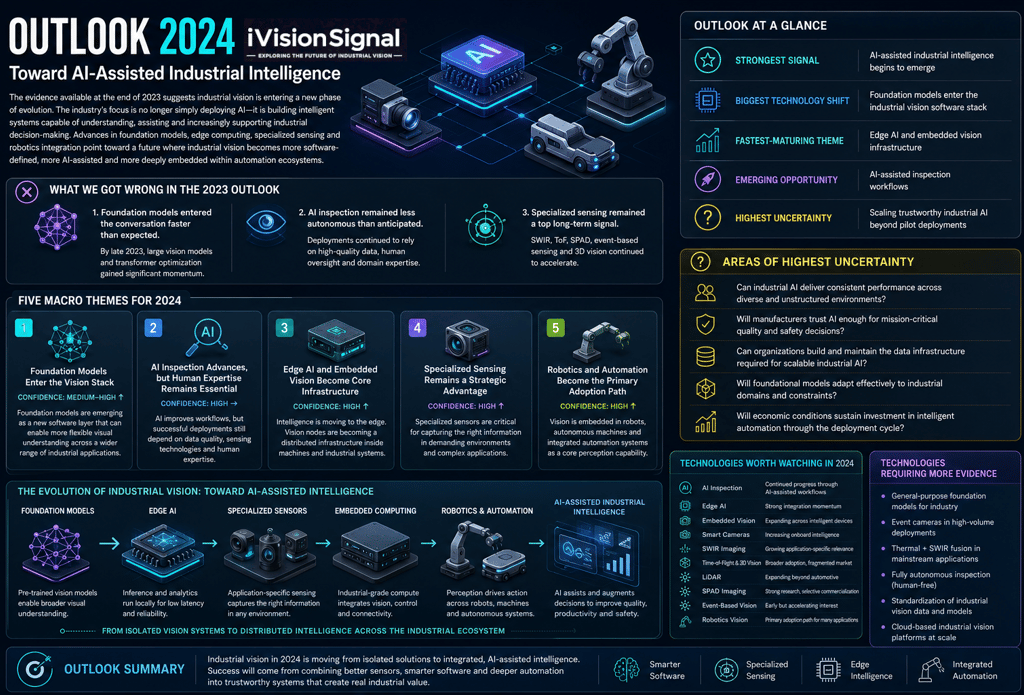
The evidence available at the end of 2023 suggests industrial vision is entering a new phase of evolution. The industry's focus is no longer simply deploying AI—it is building intelligent systems capable of understanding, assisting and increasingly supporting industrial decision-making. Advances in foundation models, edge computing, specialised sensing and robotics integration point toward a future where industrial vision becomes more software-defined, more AI-assisted and more deeply embedded within automation ecosystems.
Looking Back: What Did We Get Wrong?
What we got right
We correctly anticipated that industrial vision would become increasingly software-defined, with edge AI, embedded computing and specialized sensing continuing to converge.
What surprised us
We expected foundation models to dominate industrial vision discussions sooner. Instead, anomaly detection quietly emerged as one of the industry's most practical and commercially relevant AI deployment approaches.
Where we were too optimistic
We expected AI-assisted inspection to become significantly easier to deploy. While model performance improved, deploy
Five Macro Themes for 2024
1. Foundation Models Enter the Vision Stack
Confidence: Medium–High
By the end of 2023, foundation models had evolved from a research topic into a meaningful strategic signal for industrial vision.
Progress in transformer-based vision models, model optimization, quantization techniques and domain-specific large vision models indicates that the software layer supporting industrial vision is beginning to change.
While adoption remains early, the direction is increasingly clear.
Why it matters
Traditional machine vision relied on handcrafted rules. Deep learning relied on carefully curated datasets. Foundation models may gradually reduce development effort by enabling more flexible visual understanding across a wider range of industrial applications.
For 2024, however, this remains an emerging signal rather than an established deployment trend.
2. AI Inspection Advances, but Human Expertise Remains Essential
Confidence: High
AI inspection continues to strengthen across manufacturing, semiconductor inspection, safety monitoring and quality control.
Yet the strongest evidence suggests AI is improving industrial workflows rather than replacing human expertise. Successful deployments continue to depend on high-quality data, appropriate sensing technologies and well-designed production processes.
Why it matters
The industry's near-term opportunity is AI-assisted inspection rather than fully autonomous inspection. Progress will continue to come through better integration between people, AI and industrial processes.
3. Edge AI and Embedded Vision Become Core Infrastructure
Confidence: High
Edge computing and embedded vision are increasingly transitioning from emerging technologies into foundational industrial infrastructure.
Industrial computers, embedded AI platforms, rugged edge systems, software-defined cameras and interoperable vision platforms all point toward a future where intelligence is embedded directly inside machines.
Why it matters
Industrial vision is no longer simply capturing images. It is becoming a distributed network of intelligent perception nodes capable of analysing, interpreting and responding locally.
4. Specialized Sensing Remains a Strategic Advantage
Confidence: High
Sensor innovation remains one of the strongest evidence clusters entering 2024.
Continued advances across SWIR, Time-of-Flight, SPAD, event-based sensing, thermal imaging, near-infrared imaging, stereo vision and HDR CMOS reinforce the growing importance of application-specific sensing technologies.
Why it matters
Artificial intelligence cannot compensate for information that was never captured. As industrial environments become increasingly demanding, specialized sensing remains fundamental to reliable AI performance.
The industry's most capable systems will increasingly combine better sensing with better intelligence.
5. Robotics and Automation Become the Primary Adoption Path
Confidence: High
The strongest commercial momentum continues to come from industrial vision embedded inside broader automation systems.
Applications including robotic bin picking, logistics automation, agricultural robotics, autonomous machines and integrated factory automation increasingly treat vision as a core perception capability rather than an independent subsystem.
Why it matters
The market is shifting from purchasing cameras toward deploying intelligent automation systems. Future ecosystem leadership is increasingly likely to come from robotics platforms, automation vendors, machine builders and system integrators capable of delivering complete perception solutions.
Outlook at a Glance
Strongest Signal AI-assisted industrial intelligence begins to emerge
Biggest Technology Shift Foundation models enter the industrial vision software stack
Fastest-Maturing Theme Edge AI and embedded vision infrastructure
Emerging Opportunity AI-assisted inspection workflows
Highest Uncertainty Scaling trustworthy industrial AI beyond pilot deployments
Technologies Worth Watching in 2024
AI Inspection Continued progress through AI-assisted workflows
Edge AI Strong integration momentum
Embedded Vision Becoming core industrial infrastructure
Smart Cameras Increasing onboard intelligence
Foundation & Large Vision Models Early but strategically important
SWIR Imaging Strong application-specific growth
Time-of-Flight & 3D Vision Continued expansion
Event-Based Vision Early signal strengthening
SPAD Imaging Strong research and selective commercialization
Thermal, NIR & Spectral Imaging Growing role in demanding inspection tasks
Robotics Vision Strong adoption momentum
Sensor Fusion Increasing importance for autonomous systems
Technologies Requiring More Evidence
Several emerging technologies continue to strengthen as long-term signals but remain at an early stage of industrial maturity.
These include:
Fully autonomous visual inspection
Foundation models for large-scale industrial deployment
Event-based vision
Commodity 3D vision
Universal industrial AI platforms
Each represents an important direction of travel, but current evidence continues to favour application-specific deployments over broadly standardized solutions.
Areas of Highest Uncertainty
The defining uncertainties entering 2024 concern operational maturity rather than technological capability.
Key questions include:
Can foundation models meaningfully reduce deployment effort in industrial vision?
Will AI inspection become repeatable across factories, products and defect types?
Can edge AI platforms deliver the reliability and lifecycle support expected in industrial environments?
Will smart cameras simplify deployment or increase system complexity?
Which specialized sensing technologies will expand beyond premium applications?
Can robotics and automation integrators transform AI vision into repeatable industrial solutions rather than bespoke projects?
Outlook Summary
Industrial vision enters 2024 as an increasingly software-defined and AI-assisted perception ecosystem.
The strongest evidence available at the end of 2023 suggests the industry's future will be shaped by the convergence of specialized sensing, edge computing, embedded AI, robotics integration and the early emergence of foundation models.
Research remains active. Commercialization continues to broaden. Integration is strengthening. Adoption, however, remains constrained by deployment complexity and application-specific engineering.
The defining question for 2024 is no longer whether AI will transform industrial vision. It already has. The challenge now is whether the ecosystem can transform these increasingly capable technologies into trusted, repeatable and scalable industrial systems.
Connect
Questions? Reach out anytime.
hello@ivisionsignal.com
© 2025. All rights reserved.