
2023 Outlook - Toward Distributed Industrial Perception
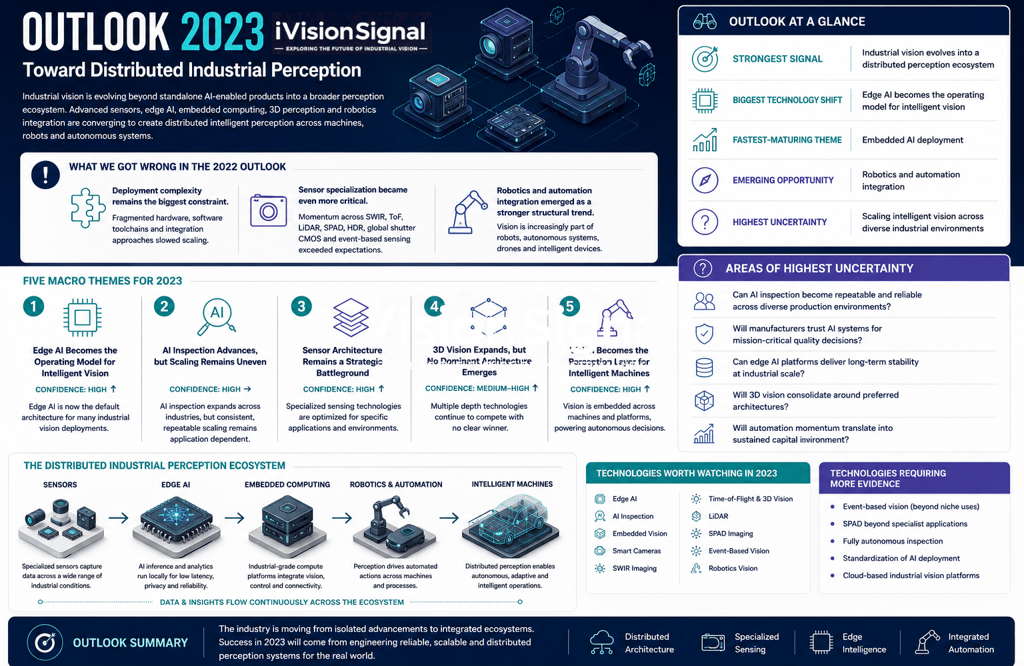
The evidence available at the end of 2022 suggests industrial vision is evolving beyond standalone AI-enabled products into a broader perception ecosystem. Rather than relying on a single breakthrough, the industry is converging around multiple complementary technologies—including specialized sensors, edge AI, embedded computing, 3D perception and robotics integration. Together, these advances point toward a future where intelligent perception is increasingly distributed across machines, robots and autonomous systems rather than confined to dedicated vision stations.
Looking Back: What Did We Get Wrong?
What we got right
We correctly identified edge AI, specialise sensing and embedded vision as the industry's strongest structural trends. These themes continued strengthening across research, commercialisation and industrial integration.
What surprised us
We underestimated how rapidly industrial vision became intertwined with robotics and autonomous systems. By the end of 2022, vision was increasingly being deployed as part of broader automation platforms rather than traditional inspection stations.
Where we were too optimistic
We expected AI inspection to become more standardized across industries. Instead, deployment remained highly application-specific, with significant variation in data requirements, workflows and engineering effort.
Five Macro Themes for 2023
1. Edge AI Becomes the Operating Model for Intelligent Vision
Confidence: High
By the end of 2022, edge AI is no longer an emerging technology—it has become the default architecture for many industrial vision deployments.
Progress across embedded AI modules, smart cameras, FPGA platforms, software-defined cameras and industrial deployment workflows reflects a growing consensus that image processing, inference and decision-making should occur close to where data is generated.
Why it matters
The industry's most significant shift is architectural. Cameras are evolving from image acquisition devices into intelligent systems capable of analysing and acting locally, strengthening confidence that edge AI will form the long-term foundation of industrial vision.
2. AI Inspection Advances, but Scaling Remains Uneven
Confidence: High
AI inspection continues expanding across defect detection, quality inspection and factory automation. However, evidence still points to selective adoption rather than widespread commodity deployment.
Performance continues to depend heavily on data quality, application complexity and integration expertise.
Why it matters
The question is no longer whether AI can inspect. It is whether AI inspection can become repeatable, reliable and scalable across diverse industrial environments.
3. Sensor Architecture Remains a Strategic Battleground
Confidence: High
Sensor innovation continues to accelerate across SWIR, SPAD, Time-of-Flight, LiDAR, HDR, global shutter CMOS, event-based sensing, hyperspectral imaging and low-light architectures.
Rather than competing primarily on image quality, sensors are increasingly optimized for specific operating environments and industrial applications.
Why it matters
Industrial vision is not moving from sensors to AI. It is moving toward better combinations of sensing and intelligence. As applications become more demanding, specialized sensing increasingly determines overall system performance.
4. 3D Vision Expands, but No Dominant Architecture Emerges
Confidence: Medium–High
Demand for depth perception continues growing across robotics, autonomous systems, logistics and industrial automation.
At the same time, stereo vision, Time-of-Flight, structured light, LiDAR and SPAD continue evolving in parallel, with no clear winner emerging.
Why it matters
The market is converging on the need for depth, but not on a single technology. Success will continue to depend on matching sensing architecture to application requirements rather than expecting one universal solution.
5. Vision Becomes the Perception Layer for Intelligent Machines
Confidence: High
Industrial vision is increasingly embedded inside robots, autonomous vehicles, drones, factory automation systems and intelligent edge devices.
Rather than existing as an independent subsystem, vision is becoming the perception layer that enables autonomous decision-making across a growing range of industrial platforms.
Why it matters
This represents a structural shift in industry value creation. Competitive advantage is increasingly moving toward organizations capable of integrating sensing, computing, AI and automation into complete perception systems.
Outlook at a Glance
Strongest Signal Industrial vision evolves into a distributed perception ecosystem
Biggest Technology Shift Edge AI becomes the operating model for intelligent vision
Fastest-Maturing Theme Embedded AI deployment
Emerging Opportunity Robotics and automation integration
Highest Uncertainty Scaling intelligent vision across diverse industrial environments
Technologies Worth Watching in 2023
Edge AI Becoming the default deployment architecture
AI Inspection Continued progress, uneven scaling
Embedded Vision Strong expansion across intelligent devices
Smart Cameras Increasing onboard intelligence
SWIR Imaging Growing application-specific relevance
Time-of-Flight & 3D Vision Broader adoption, fragmented market
LiDAR Expanding beyond automotive applications
SPAD Imaging Strong research, selective commercialization
Event-Based Vision Early but increasingly worth watching
HDR & Global Shutter CMOS Continued industrial relevance
Hyperspectral & Multispectral Imaging Expanding specialist applications
Robotics Vision Strong integration momentum
Sensor Fusion Increasing importance for autonomous systems
Technologies Requiring More Evidence
Several technologies continue to strengthen as long-term signals but have yet to demonstrate broad industrial adoption.
These include:
Event-based vision
Fully autonomous inspection
General-purpose industrial AI platforms
Mainstream SPAD-based industrial vision
Commodity 3D vision
Each shows encouraging progress, but current evidence continues to favour specialized, application-driven deployment over universal adoption.
Areas of Highest Uncertainty
The industry's biggest uncertainties are increasingly practical rather than technical.
Key questions include:
Can AI inspection become repeatable across diverse production environments?
Will smart cameras simplify deployment or introduce new system complexity?
Can edge AI platforms deliver the reliability expected throughout long industrial lifecycles?
Which depth-sensing technologies will prove most durable across industrial applications?
Will event-based vision move beyond specialist markets?
Can sensor fusion become a mainstream industrial vision architecture rather than remaining concentrated in robotics?
Outlook Summary
Industrial vision enters 2023 as an increasingly distributed perception ecosystem rather than a collection of independent technologies.
The strongest evidence available at the end of 2022 suggests the industry's future will be shaped not by a single breakthrough, but by the convergence of specialized sensing, edge AI, embedded computing, 3D perception and automation integration.
Research remains active. Commercialization continues to broaden. Integration is strengthening. Adoption, however, remains selective and application specific.
The defining question for 2023 is no longer whether industrial vision can become intelligent. It is whether intelligent perception can become sufficiently reliable, scalable and trusted to operate as a foundational layer across the next generation of industrial automation systems.
Connect
Questions? Reach out anytime.
hello@ivisionsignal.com
© 2025. All rights reserved.