
2022 Outlook - Toward Intelligent Perception
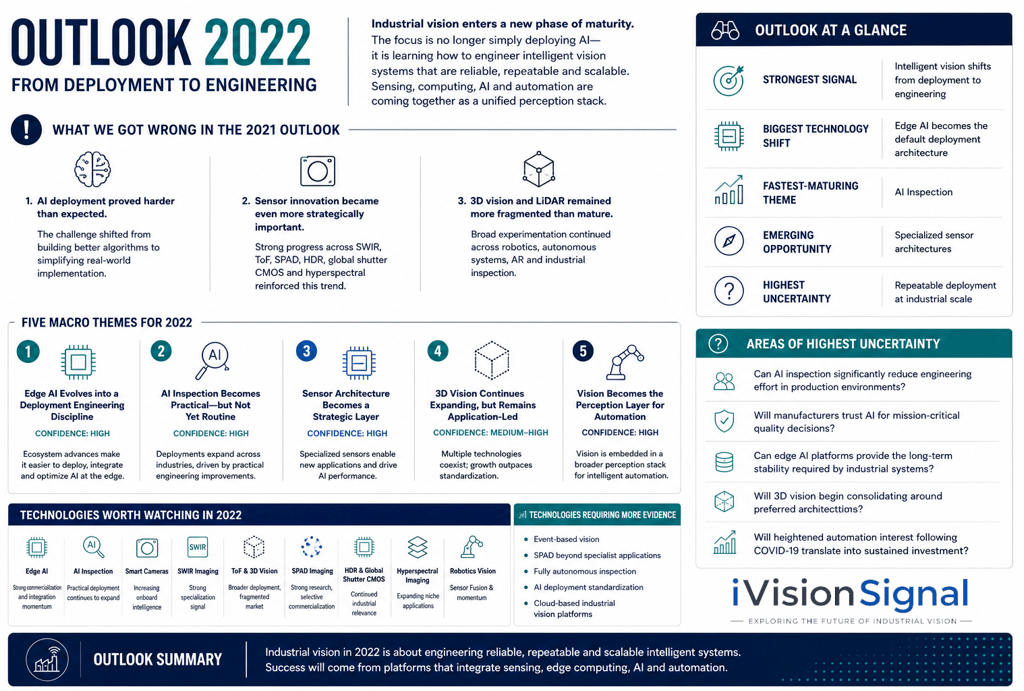
The evidence available at the end of 2021 suggests industrial vision is entering a new phase of maturity. The industry's focus is no longer simply deploying AI—it is learning how to engineer intelligent vision systems that are reliable, repeatable and scalable. Advances in edge computing, specialized image sensors, embedded platforms and software-defined architectures indicate that industrial vision is evolving into a complete perception stack, where sensing, computing, AI and automation increasingly operate as a unified system.
Looking Back: What Did We Get Wrong?
What we got right
We correctly anticipated that edge AI would become the preferred deployment architecture for intelligent industrial vision. Commercial platforms, smart cameras and embedded AI systems continued to mature throughout 2021.
What surprised us
We underestimated the resilience of traditional machine vision. Rather than replacing deterministic algorithms, AI increasingly complemented them, resulting in hybrid inspection systems that combined conventional image processing with deep learning.
Where we were too optimistic
We expected deployment engineering to mature faster. In practice, much of the industry's effort shifted toward simplifying model training, deployment workflows and lifecycle management rather than expanding large-scale adoption.
Five Macro Themes for 2022
1. Edge AI Evolves into a Deployment Engineering Discipline
Confidence: High
By the end of 2021, edge AI is no longer simply about hardware availability. The industry's attention is increasingly focused on deployment engineering—optimizing inference, integrating AI workflows and building platforms that simplify industrial implementation.
Advances in embedded processors, FPGA-based vision systems, software-defined cameras and AI deployment toolchains all point toward a maturing ecosystem designed to make intelligent vision practical outside specialist development teams.
Why it matters
The industry's next competitive advantage is no longer better AI models alone. It is the ability to deploy, maintain and scale AI reliably across real industrial environments.
2. AI Inspection Becomes Practical—but Not Yet Routine
Confidence: High
AI inspection remains one of the strongest long-term signals entering 2022.
Commercial deployments continue expanding across defect detection, quality inspection, automotive manufacturing and smart factories. However, evidence suggests adoption is progressing through practical engineering improvements rather than rapid industry-wide transformation.
Why it matters
The industry has largely accepted that AI works. The remaining challenge is building systems that perform consistently across varying products, lighting conditions and production environments.
3. Sensor Architecture Becomes a Strategic Layer
Confidence: High
Sensor innovation remains one of the strongest signals across the industrial vision ecosystem.
Activity continues to accelerate across SWIR, SPAD, Time-of-Flight, HDR, global shutter CMOS, low-light imaging, hyperspectral and multispectral sensing, alongside continued advances in stacked CMOS architectures.
Why it matters
As industrial applications become more demanding, sensing quality increasingly determines AI performance. Rather than reducing the importance of image sensors, artificial intelligence is driving demand for more specialized sensing technologies tailored to specific operating environments.
4. 3D Vision Continues Expanding, but Remains Application-Led
Confidence: Medium–High
3D vision continues gaining momentum across robotics, logistics, autonomous systems and industrial inspection.
Time-of-Flight, stereo vision, SPAD and LiDAR all continue advancing, yet the market remains characterised by multiple competing approaches rather than a single dominant architecture.
Why it matters
The opportunity continues to broaden, but technology selection remains highly application dependent. Growth is accelerating faster than standardization.
5. Vision Becomes the Perception Layer for Automation
Confidence: High
Machine vision is increasingly embedded inside robotics, autonomous vehicles, drones, inspection systems and connected industrial infrastructure rather than deployed as an independent subsystem.
The strongest ecosystem signal is that vision is becoming part of a broader perception stack supporting intelligent automation.
Why it matters
Industry value continues shifting toward integrated solutions that combine sensing, embedded computing, AI software and automation. Future competitive advantage is increasingly likely to come from complete perception platforms rather than individual hardware components.
Outlook at a Glance
CategoryAssessmentStrongest SignalIntelligent vision shifts from deployment to engineeringBiggest Technology ShiftEdge AI becomes the default deployment architectureFastest-Maturing ThemeAI InspectionEmerging OpportunitySpecialized sensor architecturesHighest UncertaintyRepeatable deployment at industrial scale
Technologies Worth Watching in 2022
ThemeOutlookEdge AIStrong commercialization and integration momentumAI InspectionPractical deployment continues to expandEmbedded VisionContinued growth across intelligent devicesSmart CamerasIncreasing onboard intelligenceSWIR ImagingStrong specialization signalTime-of-Flight & 3D VisionBroader deployment, fragmented marketSPAD ImagingStrong research, selective commercializationGlobal Shutter CMOSContinued industrial relevanceHyperspectral & Multispectral ImagingExpanding niche applicationsRobotics VisionStrong integration momentumSensor FusionIncreasing importance for autonomous systemsFPGA Vision ProcessingGrowing relevance for low-latency edge AI
Technologies Requiring More Evidence
Several technologies continue to demonstrate promising long-term potential but have yet to establish broad industrial momentum.
These include:
Event-based vision
Fully autonomous inspection
SPAD as a mainstream industrial imaging technology
Cloud-centric industrial vision
General-purpose AI vision platforms
Each remains an important area to monitor, but current evidence continues to favour specialized, application-driven deployments over universal solutions.
Areas of Highest Uncertainty
Industrial vision is no longer constrained by technical feasibility. The defining questions entering 2022 concern deployment, scalability and operational maturity.
Key questions include:
Can AI inspection be deployed reliably across diverse production environments?
Will edge AI platforms achieve the long-term stability required for industrial lifecycles?
Can smart cameras simplify system design rather than relocate complexity into the device?
Which 3D sensing architectures will emerge as preferred solutions for specific applications?
Will specialized sensors remain premium technologies or become mainstream industrial tools?
Can system integrators develop repeatable AI vision solutions instead of one-off implementations?
Outlook Summary
Industrial vision enters 2022 not in search of new capabilities, but in pursuit of better engineering.
The strongest evidence available at the end of 2021 suggests the industry is transitioning from isolated AI deployments toward complete intelligent perception systems that combine specialized sensing, edge computing, AI software and automation integration.
Research remains strong. Commercialization continues to accelerate. Integration is steadily improving. Adoption, however, remains selective and application-led.
Rather than expecting a single breakthrough technology to define the year ahead, 2022 is more likely to be remembered as the point where industrial vision began learning how to make intelligent systems practical, scalable and repeatable across real industrial environments.
Connect
Questions? Reach out anytime.
hello@ivisionsignal.com
© 2025. All rights reserved.