
2021 Outlook - Toward Deployable AI Vision
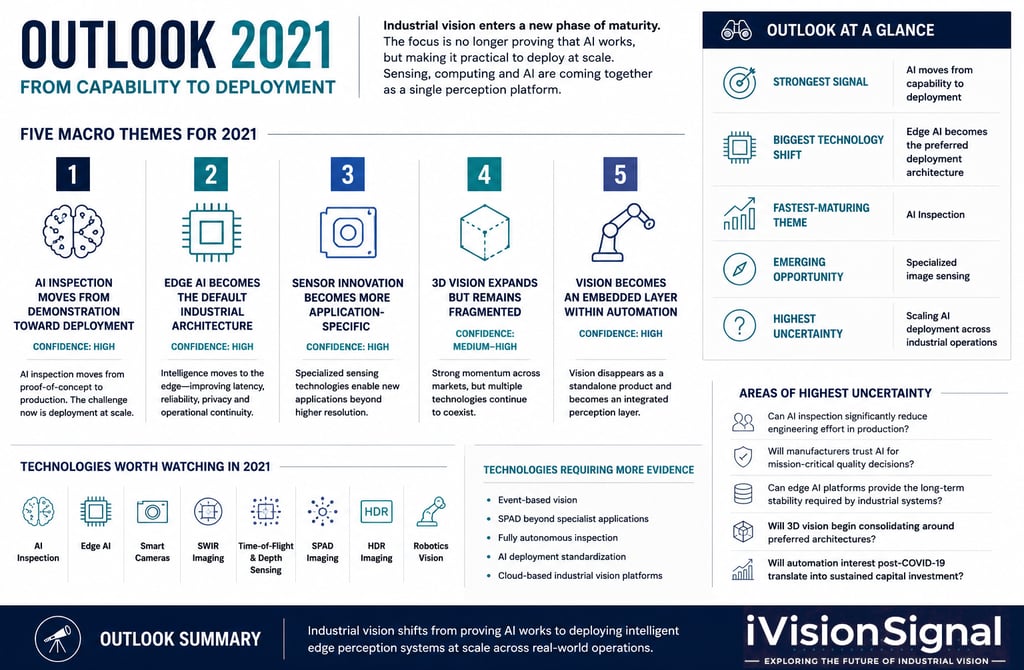
The evidence available at the end of 2020 suggests industrial vision is entering a new phase of maturity. The industry's focus is no longer proving that AI works, but making it practical to deploy at scale. Advances in edge computing, specialized image sensors and automation integration indicate that industrial vision is evolving into a layered intelligent system—where sensing, computing and AI increasingly operate together as a single perception platform.
Looking Back: What Did We Get Wrong?
What we got right
We correctly identified AI, edge computing and embedded vision as the industry's primary long-term direction. Throughout 2020, evidence increasingly showed industrial vision evolving beyond standalone cameras toward intelligent edge systems.
What surprised us
We underestimated how quickly AI became accessible to non-specialists. Rather than remaining confined to research groups, 2020 saw an expanding ecosystem of AI-enabled software, development kits and edge hardware designed to lower the barrier to industrial deployment.
Where we were too optimistic
We expected AI inspection to move into production more rapidly than it did. The technology continued advancing, but deployment remained constrained by integration complexity, data quality and the operational disruption caused by the global pandemic.
Five Macro Themes for 2021
1. AI Inspection Moves from Demonstration Toward Deployment
Confidence: High
By the end of 2020, AI had progressed well beyond research. Evidence now spans optimized neural networks, AI-enabled processors, embedded inference hardware, machine vision software with integrated deep learning workflows and an increasing number of production inspection deployments.
The industry's conversation is shifting from whether AI belongs in machine vision to how it can be deployed efficiently across real manufacturing environments.
Why it matters
The next challenge is no longer technical capability—it is deployment at scale. The companies that simplify AI implementation are likely to accelerate adoption far more than those focused solely on model performance.
2. Edge AI Becomes the Default Industrial Architecture
Confidence: High
Edge computing emerged as the preferred deployment model throughout 2020.
Commercial activity around embedded AI modules, inference accelerators, smart cameras and industrial edge computers reflects a growing consensus that intelligence should reside alongside the sensor rather than in centralized cloud infrastructure.
Why it matters
This represents a fundamental architectural shift.
Industrial vision systems are increasingly expected to capture, analyse and respond locally, improving latency, reliability, privacy and operational continuity for industrial environments.
3. Sensor Innovation Becomes More Application-Specific
Confidence: High
Sensor innovation remained one of the strongest signals throughout 2020.
Rather than competing primarily on resolution, the market is expanding across specialized sensing technologies including SWIR, SPAD, Time-of-Flight, HDR, global shutter, low-light imaging and multispectral sensing.
Why it matters
Industrial applications increasingly require different sensing capabilities rather than a single universal camera architecture. Sensor innovation is becoming more targeted, enabling new applications instead of simply improving existing ones.
4. 3D Vision Expands but Remains Fragmented
Confidence: Medium–High
3D vision continues to gain momentum across robotics, logistics, automotive, inspection and mobile sensing.
However, multiple competing technologies—including stereo vision, structured light, LiDAR and Time-of-Flight—continue to evolve in parallel, with no clear industry standard emerging.
Why it matters
The opportunity continues to expand, but technology selection remains highly application dependent. Market growth is likely to outpace market consolidation over the near term.
5. Vision Becomes an Embedded Layer Within Automation
Confidence: High
Perhaps the strongest ecosystem signal is that machine vision is increasingly disappearing as a standalone product category.
Instead, vision is becoming an integrated perception layer inside robotics, autonomous systems, smart factories, logistics platforms and AI-enabled edge devices.
Why it matters
Industry value is shifting beyond cameras toward complete intelligent systems. Success will increasingly depend on the ability to combine sensing, computing, AI and automation into integrated solutions.
Outlook at a Glance
Strongest Signal AI moves from capability to deployment
Biggest Technology Shift Edge AI becomes the preferred deployment architecture
Fastest-Maturing Theme I Inspection
Emerging Opportunity Specialized image sensing
Highest Uncertainty Scaling AI deployment across industrial operations
Technologies Worth Watching in 2021
Inspection Strong momentum, early adoption
Edge AI Strong commercialization and integration
Embedded Vision Continued expansion
Smart Cameras Increasing intelligence at the device
SWIR Imaging Growing specialization
Time-of-Flight & Depth Sensing Strong activity, fragmented adoption
SPAD Imaging Strong research, selective commercialization
Global Shutter CMOS Continued industrial relevance
HDR Imaging Increasing adoption
Robotics Vision Strong integration momentum
Technologies Requiring More Evidence
Several technologies continue to show promise but have yet to demonstrate widespread industrial adoption.
These include:
Event-based vision
SPAD beyond specialist applications
Fully autonomous inspection
AI deployment standardization
Cloud-based industrial vision platforms
Each represents an important area of research and commercial development, but current evidence remains insufficient to suggest broad ecosystem adoption.
Areas of Highest Uncertainty
The defining uncertainty entering 2021 is no longer technical feasibility—it is operational adoption.
Key questions include:
Can AI inspection significantly reduce engineering effort in production environments?
Will manufacturers trust AI for mission-critical quality decisions?
Can edge AI platforms provide the long-term stability required by industrial systems?
Will 3D vision begin consolidating around preferred architectures?
Will heightened automation interest following COVID-19 translate into sustained capital investment?
Outlook Summary
Industrial vision enters 2021 not as an industry searching for its next breakthrough, but as one learning how to deploy the technologies it has already developed.
Research continues to advance rapidly. Commercialization is accelerating. Integration is improving. Adoption, however, remains selective.
The strongest long-term signal is increasingly clear: industrial vision is evolving into an intelligent edge perception layer that combines advanced sensing, embedded computing, artificial intelligence and automation into a unified system.
The question for 2021 is no longer whether this transition will occur—it is how quickly the industry can move from isolated deployments to widespread operational adoption.
Connect
Questions? Reach out anytime.
hello@ivisionsignal.com
© 2025. All rights reserved.