2020 Outlook - From Cameras to Intelligent Systems
The evidence available at the end of 2019 points to an industry entering a period of structural change rather than incremental evolution. Advances in artificial intelligence, edge computing, image sensors and automation are increasingly converging, shifting industrial vision beyond standalone cameras toward intelligent, integrated systems. While the pace of adoption remains uneven, these five macro themes represent the strongest signals likely to shape the direction of the industrial vision ecosystem throughout 2020.
Five Macro Themes for 2020
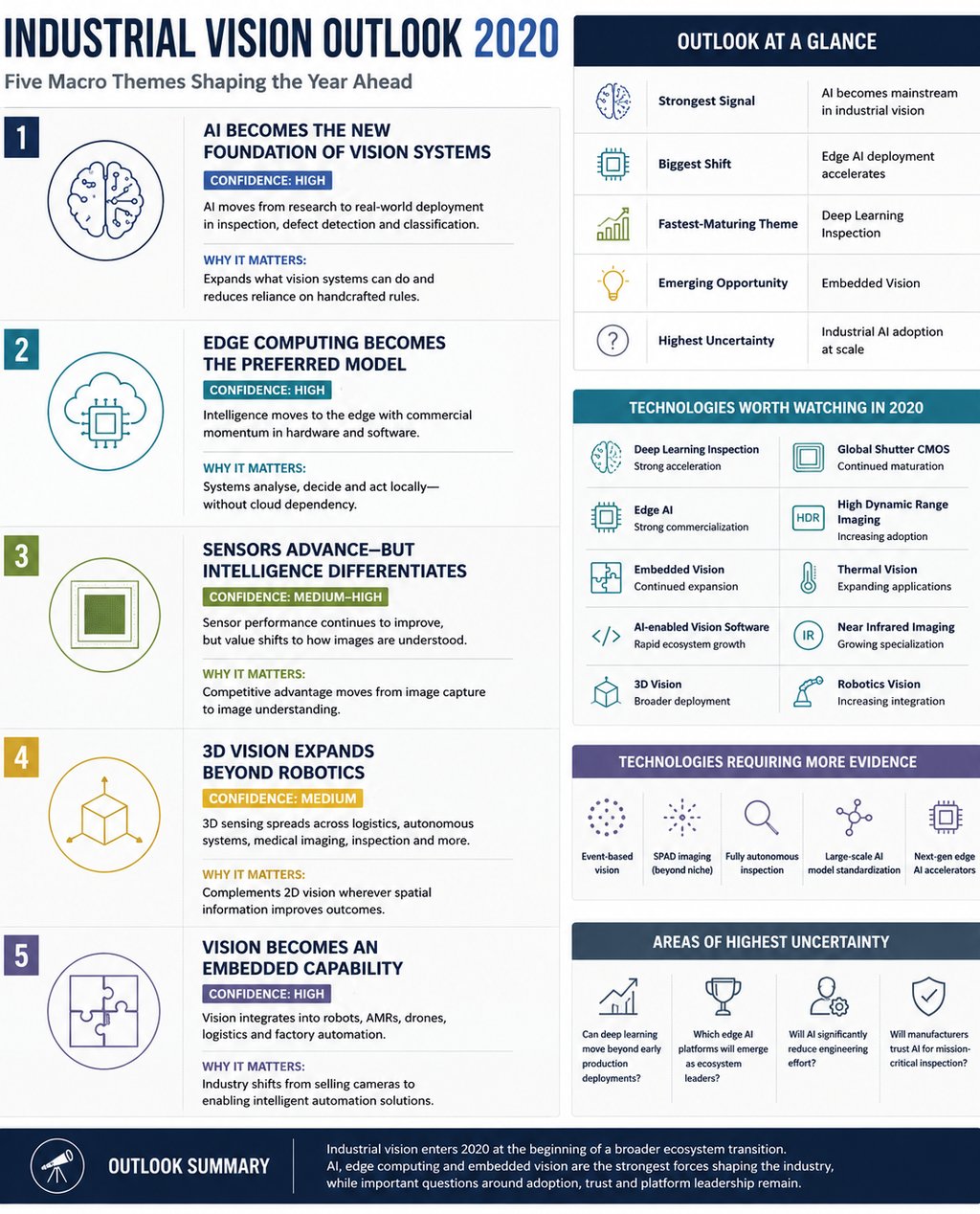
1. Industrial Vision Becomes an AI System, Not Simply a Camera System
Confidence: High
The strongest signal entering 2020 is the transition of industrial vision from deterministic image processing toward AI-assisted perception.
Evidence gathered throughout 2019 shows progress across the entire technology stack—from advances in neural network research to the commercial availability of edge AI hardware and the integration of deep learning into mainstream machine vision software. Early production deployments in inspection, defect detection and classification further suggest AI is moving beyond the laboratory.
Why it matters
Industrial vision is no longer evolving solely through better cameras and algorithms. AI is becoming a standard engineering capability, expanding what vision systems can detect while reducing dependence on handcrafted rules.
2. Edge Computing Emerges as the Preferred Deployment Model
Confidence: High
Edge AI has become one of the industry's most consistent themes.
Commercial momentum spans NVIDIA Jetson platforms, industrial edge computers, embedded AI modules and software optimized for local inference. Rather than assuming cloud processing will dominate, vendors increasingly position intelligence at the device itself.
Why it matters
Edge computing represents an architectural shift rather than simply a hardware upgrade.
Industrial vision systems are increasingly expected to analyse images, make decisions and respond autonomously without depending on cloud connectivity.
3. Sensors Continue Advancing—but Intelligence Is Becoming the Differentiator
Confidence: Medium–High
Image sensor innovation remains exceptionally strong, with continued advances in global shutter, HDR, stacked architectures, backside illumination, scientific CMOS and specialized imaging technologies.
However, commercial messaging increasingly positions sensors as enabling components within larger AI-enabled systems rather than the primary source of competitive differentiation.
Why it matters
Higher-performance sensors remain essential, but system intelligence is becoming the primary driver of value creation. Competitive advantage is gradually shifting from image capture toward image understanding.
4. 3D Vision Expands Beyond Traditional Robotics
Confidence: Medium
3D vision continues to broaden into applications including logistics, autonomous systems, medical imaging, inspection and robotics.
Multiple sensing approaches—including stereo vision, structured light and time-of-flight—continue to coexist, with no single architecture emerging as the dominant solution.
Why it matters
Rather than replacing conventional 2D vision, 3D sensing increasingly complements it wherever spatial information improves automation performance.
5. Industrial Vision Becomes an Embedded Capability
Confidence: High
Industrial vision increasingly appears as part of broader automation solutions rather than as a standalone product category.
Throughout 2019, vision technologies were increasingly integrated into collaborative robots, autonomous mobile robots, drones, logistics platforms and factory automation systems.
Why it matters
The industry is shifting from selling cameras toward enabling intelligent automation. Future purchasing decisions are increasingly likely to focus on complete solutions rather than individual vision components.
Outlook at a Glance
Strongest Signal AI becomes mainstream in industrial vision
Biggest Technology Shift Edge AI deployment accelerates
Fastest-Maturing Theme Deep Learning Inspection
Emerging Opportunity Embedded Vision
Highest Uncertainty Industrial AI adoption at scale
Technologies Worth Watching in 2020
Deep Learning Inspection Strong acceleration expected
Edge AI Strong commercialization expected
Embedded Vision Continued expansion
AI-enabled Vision Software Rapid ecosystem growth
3D Vision Broader deployment
Global Shutter CMOS Continued maturation
High Dynamic Range Imaging Increasing adoption
Thermal Vision Expansion into industrial applications
Near Infrared Imaging Growing specialization
Robotics Vision Increasing system integration
Technologies Requiring More Evidence
Several promising technologies remain at an early stage of ecosystem maturity and have yet to demonstrate widespread commercial momentum.
These include:
Event-based vision
SPAD imaging beyond specialist markets
Fully autonomous industrial inspection
Large-scale AI model standardization
Vision foundation models
Next-generation edge AI accelerators
These themes warrant continued monitoring but do not yet materially alter the industry's near-term outlook.
Areas of Highest Uncertainty
Despite strong technology momentum, several important questions remain unresolved entering 2020.
Can deep learning move beyond early production deployments?
Research progress is substantial, but widespread industrial adoption remains in its early stages.
Which edge AI platforms will emerge as ecosystem leaders?
Competition is accelerating, but long-term platform dominance remains uncertain.
Will AI significantly reduce engineering effort?
Many vendors promise simpler deployment and lower development costs, yet evidence of sustained productivity gains remains limited.
Will manufacturers trust AI for mission-critical inspection?
Technical capability is advancing rapidly, but confidence in AI-driven decision-making continues to lag, particularly in high-reliability environments.
Outlook Summary
Industrial vision enters 2020 at the beginning of a broader ecosystem transition rather than on the verge of a single disruptive breakthrough.
The strongest evidence available at the end of 2019 suggests the industry's centre of gravity is shifting away from standalone imaging hardware and toward integrated intelligent systems that combine advanced sensors, edge computing, machine learning and automation.
Rather than asking whether AI will become part of industrial vision, the more relevant question entering 2020 is how quickly the ecosystem can mature from early deployments to widespread industrial adoption.
The direction of travel appears increasingly clear. The pace of adoption, however, remains the defining uncertainty for the years ahead.
Connect
Questions? Reach out anytime.
hello@ivisionsignal.com
© 2025. All rights reserved.